The Case for Life on Venus
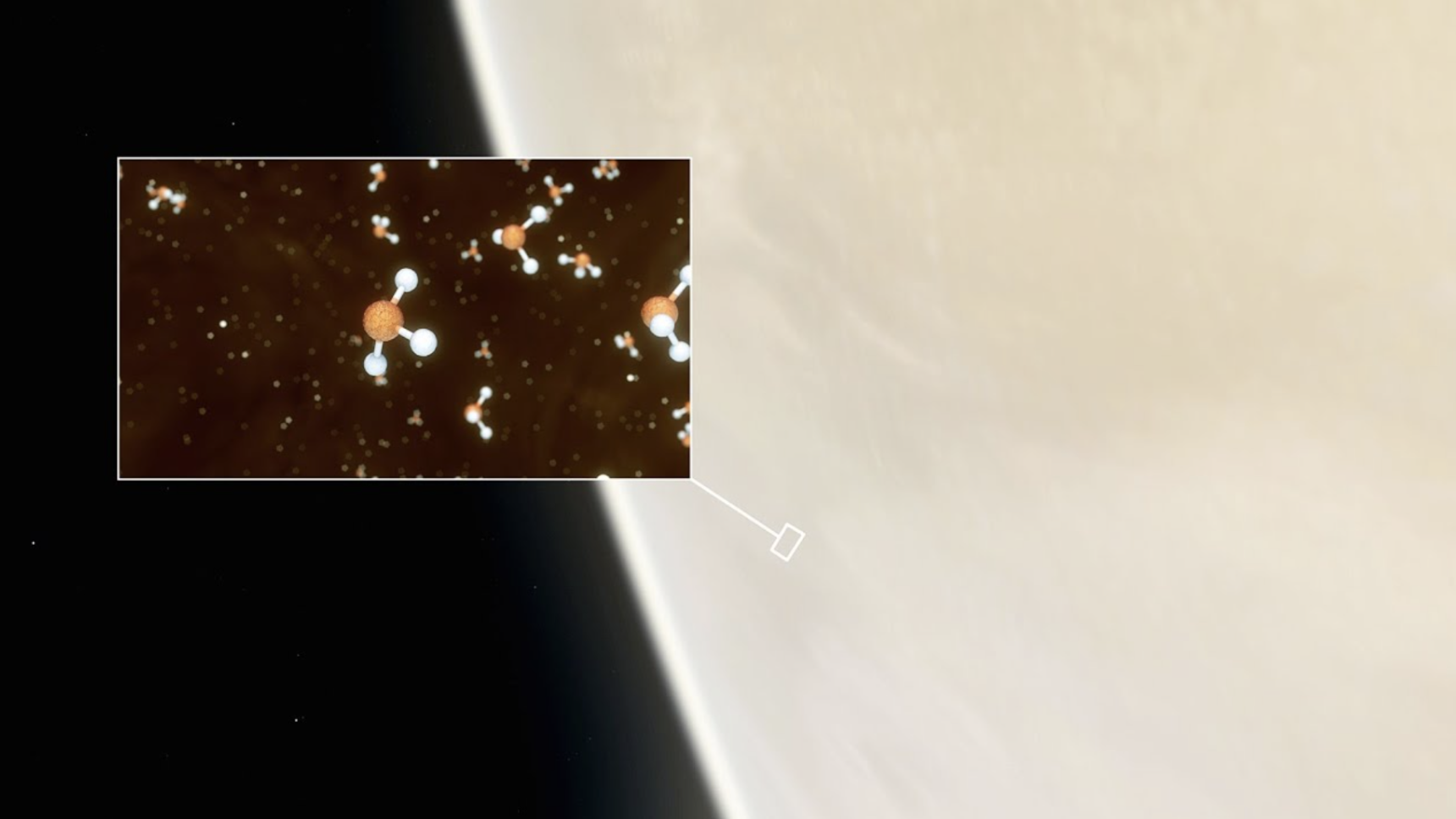
Phosphine gas was detected in Venusian clouds, which could possibly be evidence of life on Venus (European Southern Observatory (ESO), 2020)
Life on Venus? Seriously?
At first glance, Venus seems like the last place to look for life. Often called Earth’s “evil twin”, it’s about the same size as our planet, but that’s where the similarities end. Venus is wrapped in thick clouds of carbon dioxide and sulfuric acid, with surface temperatures over 426°C that are hot enough to melt lead (Limaye, 2025).
But about 50 kilometers above the surface, the atmosphere, temperatures and pressures on Venus are surprisingly similar to those on Earth (Limaye, 2025). That’s why scientists have started wondering: could microscopic life exist up there, among the Venusian clouds? This idea has roots in an old mystery. For more than a century, astronomers have known that Venus’s clouds absorb ultraviolet (UV) light in strange ways (Limaye et al., 2018). The cause is still unknown, but some Earth bacteria and organic molecules absorb UV light in similar patterns, raising the question of whether something biological could be behind it.
The Mystery of Phosphine
In 2020, a team of researchers announced they had detected phosphine gas (PH3) in Venus’s atmosphere (Greaves et al., 2020). On Earth, phosphine is a toxic gas produced either by industrial processes or by microbes that live in oxygen-free environments, such as wetlands and animal intestines. Finding phosphine on a rocky planet like Venus was shocking. The gas breaks down quickly in oxygen-rich or acidic conditions and can’t form easily without hydrogen-based chemistry like that found on gas giant planets such as Jupiter. If phosphine truly existed on Venus, based on what we currently know about atmosphere chemistry, something or someone must be making it.
That’s why some researchers suggested phosphine on Venus could be a biosignature, a possible trace of microbial life. But others were skeptical (Limaye, 2025). Detecting faint chemical signals from such a bright and cloudy planet is incredibly difficult, and re-analyses of the same data produced mixed results. Some studies found weaker evidence for phosphine, while others found none at all.
A Clue from Ammonia
In 2021, another research team reported hints of ammonia (NH3) in the Venusian clouds (Bains et al. 2021). Like phosphine, ammonia shouldn’t survive long in the Venus atmosphere. Yet its presence could help explain how life, if it exists, might endure there.
Venus’s clouds are made of droplets of extremely concentrated sulfuric acid that is far too corrosive for even Earth’s most acid-loving microbes. But if ammonia were being produced somehow, it could neutralize some of that acid, creating small pockets of milder conditions. These droplets could have a pH similar to what some extremophiles on Earth can tolerate.
Moving Forward with Cautious Curiosity
At this point, no one is claiming that there is life on Venus. The signals of phosphine and ammonia might still have non-biological explanations, perhaps involving chemistry we don’t fully understand. Still, these findings have transformed how scientists view our nearest planetary neighbor. In the next decade, missions like NASA’s DAVINCI and VERITAS, and the European Space Agency’s EnVision, will explore Venus’s atmosphere and surface in unprecedented detail (NASA, 2017).
For now, Venus reminds us that the universe still holds surprises, even in places we once thought lifeless.
References
Bains, W., Petkowski, J. J., Rimmer, P. B., & Seager, S. (2021). Production of ammonia makes Venusian clouds habitable and explains observed cloud-level chemical anomalies. Proceedings of the National Academy of Sciences, 118(52), e2110889118. https://doi.org/10.1073/pnas.2110889118
European Southern Observatory. (2020). Phosphine detected in Venus’s atmosphere. Www.Eso.Org. https://www.eso.org/public/images/eso2015a/
Greaves, J. S., Richards, A. M. S., Bains, W., Rimmer, P. B., Sagawa, H., Clements, D. L., Seager, S., Petkowski, J. J., Sousa-Silva, C., Ranjan, S., Drabek-Maunder, E., Fraser, H. J., Cartwright, A., Mueller-Wodarg, I., Zhan, Z., Friberg, P., Coulson, I., Lee, E., & Hoge, J. (2021). Phosphine gas in the cloud decks of Venus. Nature Astronomy, 5(7), 655–664. https://doi.org/10.1038/s41550-020-1174-4
Limaye, S. S. (2025). Life on Venus? Life, 15(5), 717. https://doi.org/10.3390/life15050717
Limaye, S. S., Mogul, R., Smith, D. J., Ansari, A. H., Słowik, G. P., & Vaishampayan, P. (2018). Venus’ Spectral Signatures and the Potential for Life in the Clouds. Astrobiology, 18(9), 1181–1198. https://doi.org/10.1089/ast.2017.1783
NASA. (2017, November 9). Venus Exploration.https://science.nasa.gov/venus/exploration/
